
Brake Safety Day Results Show Why Defective Trucks Put Arkansas Drivers At Risk
When a commercial truck barrels down a highway and its brakes fail, the consequences can be catastrophic. A fully loaded tractor-trailer can weigh up to 80,000 pounds and requires far more stopping distance than a passenger vehicle. When the brake system is defective, that stopping distance can grow even longer. On Arkansas highways like I-40, I-55, Highway 67, and the roads connecting Jonesboro, Paragould, and communities throughout the state, brake failure can turn a close call into a deadly truck crash.
A recent one-day inspection blitz across North America brought that risk into sharp focus. According to The Trucker, inspectors conducted more than 4,000 commercial vehicle brake inspections in a single day and pulled 574 trucks off the road for brake-related violations serious enough to make continued operation hazardous. The inspection was unannounced, which means trucking companies didn’t have advance warning to prepare.
Those trucks share Arkansas roads with everyone else. When defective brakes cause a crash, the people in smaller vehicles often suffer the worst injuries. The Arkansas truck accident attorneys at McDaniel Law Firm, PLC know how to investigate brake failure claims, preserve key maintenance evidence, and hold trucking companies accountable when unsafe trucks should never have been on the road.
What Is CVSA Brake Safety Day?
The Commercial Vehicle Safety Alliance is a nonprofit organization made up of commercial motor vehicle safety enforcement and industry representatives across the United States, Canada, and Mexico. Each year, CVSA conducts Brake Safety Day, a targeted enforcement initiative in which certified inspectors focus on brake systems and components of commercial motor vehicles.
The purpose is straightforward: identify trucks with dangerous brake defects before those defects cause a crash.
Brake Safety Day is deliberately unannounced. Trucking companies and drivers don’t know it’s happening in advance. That matters because it gives inspectors a more realistic picture of fleet maintenance practices, not a polished version created for a scheduled inspection. When CVSA releases the results, they reflect the actual condition of commercial trucks operating on real roads on a normal day.
What Did The 2026 Brake Safety Day Inspections Find?
On April 14, 2026, inspectors in 47 jurisdictions across the United States, Canada, and Mexico conducted 4,021 commercial vehicle brake inspections in a single day. According to results released by CVSA, 574 vehicles, or 14.3 percent, were placed out of service for brake violations serious enough to make continued operation unsafe.
That rate jumped sharply from the prior year’s unannounced Brake Safety Day, when 8.7 percent of inspected commercial motor vehicles were placed out of service for brake-related critical inspection item violations.
More than 300 vehicles in the 2026 inspection met the 20 percent defective-brakes criterion, meaning at least one in five of the vehicles’ brakes was out of service. In the United States alone, inspectors completed 3,301 inspections and placed 460 vehicles out of service, a 13.9 percent out-of-service rate.
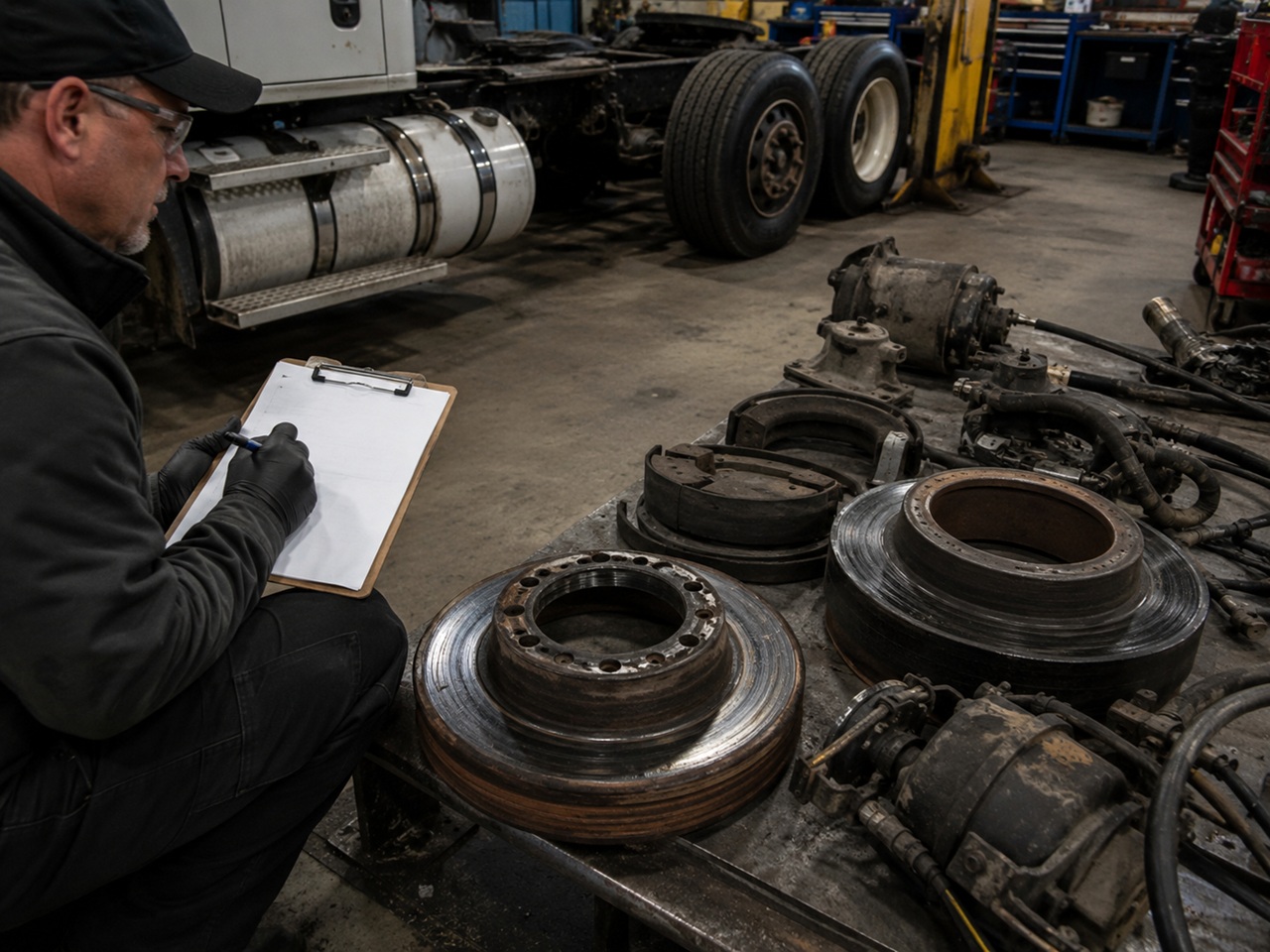
The 2026 inspection also placed special emphasis on brake drums and rotors, components that play a critical role in slowing and stopping a heavy commercial vehicle. Inspectors identified 43 drum-and-rotor violations, 21 of which were serious enough to immediately take the vehicle off the road.
These numbers are not abstractions. Every truck pulled from service that day was a warning sign about what can happen when trucking companies, drivers, or maintenance providers don’t keep brake systems in safe working order.
What Types Of Brake Violations Put Trucks Out Of Service?
Commercial trucks must meet strict federal brake standards because a brake defect on an 80,000-pound vehicle can put everyone nearby in danger. Any defect that reduces stopping capability or creates unsafe operating conditions can result in a truck being pulled from service.
The 2026 Brake Safety Day identified violations across multiple brake system components, including:
- Worn or Cracked Brake Drums and Rotors: These components absorb and dissipate heat when the brakes engage. When they deteriorate, braking performance drops, and stopping distances can increase dramatically.
- Damaged or Leaking Brake Hoses and Lines: Air or hydraulic pressure powers a truck’s brake system. A leak or rupture in a hose or line can cause partial or complete brake failure at highway speed.
- Low Braking Efficiency: Federal standards and the North American Standard Out-of-Service Criteria require a minimum braking efficiency of 43.5 percent when measured by a performance-based brake tester. Inspectors found vehicles during the 2026 blitz that failed to meet that threshold.
- 20 Percent or More Defective Brakes: When at least 20 percent of a truck’s brakes have out-of-service conditions, the vehicle can be taken off the road until the problem is fixed. More than 300 trucks met that criterion during the April inspection.
These violations often point to deeper safety problems. A truck’s brake system doesn’t usually become dangerous overnight. Worn components, ignored warning signs, incomplete inspections, and overdue repairs can all lead to the moment when a truck can’t stop in time.
Why Are Brake Failures So Dangerous In A Truck Crash?
A fully loaded tractor-trailer traveling at highway speed needs far more room to stop than a passenger car. Under ideal conditions, a fully loaded tractor-trailer traveling 65 mph may need about 525 feet to stop, nearly the length of two football fields. That assumes the brakes are working as they should.
When the brakes are defective, the driver has even less control. A truck may take longer to slow, pull to one side, jackknife, rear-end traffic ahead, or enter an intersection before it can stop. On Arkansas roads where trucks and passenger vehicles share high-speed lanes, there may be no meaningful time for other drivers to react.
FMCSA’s Large Truck Crash Causation Study found that brake problems were coded for almost 30 percent of trucks involved in the study’s crashes, compared with only 5 percent of passenger vehicles. That does not mean every brake problem caused the crash on its own, but it does show why brake maintenance has to be taken seriously.
Who Is Responsible When A Truck’s Brakes Fail?
Brake failure rarely traces back to a single cause or a single party. Federal regulations require trucking companies to inspect, repair, and maintain their vehicles. Drivers also have inspection responsibilities. Maintenance providers may be involved. In some cases, a defective component may have contributed to the failure.
When a truck with defective brakes causes a crash, potentially responsible parties may include:
- The Trucking Company: Carriers must systematically inspect, repair, and maintain vehicle brake systems. A company that skips inspections, ignores maintenance schedules, or puts a truck in service with known brake problems can be responsible for the harm that follows.
- The Truck Driver: Drivers must complete inspections and report safety defects. A driver who knows or should know about a brake problem and keeps operating the truck anyway may share responsibility.
- A Third-Party Maintenance Provider: Some trucking companies outsource inspections and repairs. If a maintenance shop performed faulty work, missed an obvious brake defect, or signed off on an unsafe vehicle, that provider may also be accountable.
- A Brake Parts Manufacturer: If a brake component was defective when it left the manufacturer, the case may include a product liability claim. That requires a careful review of the vehicle’s maintenance records, repair history, and parts history.
Identifying every responsible party matters because it affects the total compensation available to an injured victim. A thorough investigation, one that begins soon after the crash, is often the only way to uncover who knew what, when they knew it, and why the truck remained on the road.
What Evidence Matters After a Brake-Failure Truck Crash?
Truck brake failure cases depend heavily on records. The trucking company may have inspection reports, repair invoices, driver vehicle inspection reports, maintenance schedules, electronic control data, GPS records, and internal communications that show whether the brake problem was known or should have been discovered before the crash.
Important evidence may include:
- Driver Vehicle Inspection Reports: These reports can show whether the driver identified brake problems before or after trips.
- Maintenance and Repair Records: These records can reveal whether brakes were inspected, repaired, replaced, or ignored.
- Out-Of-Service History: A truck or carrier with a history of brake violations may show a pattern of unsafe maintenance practices.
- Electronic Data: Black box data, GPS information, and onboard systems may show speed, braking, and driver actions before impact.
- Physical Evidence From The Truck: Brake drums, rotors, hoses, slack adjusters, air lines, and other components may need to be preserved and inspected before repairs or disposal destroys key evidence.
- Crash Scene Evidence: Skid marks, impact locations, vehicle damage, roadway evidence, and witness statements can help reconstruct what happened.
McDaniel Law Firm, PLC knows how to investigate truck accidents and pursue the evidence that trucking companies and insurers may already be working to control. The firm’s truck accident investigation work often includes maintenance records, black box data, safety records, driver logs, and other evidence that can reveal negligence by the trucking company.
How Do Trucking Companies Defend Brake Failure Claims?
Trucking companies rarely admit that poor maintenance caused a crash. Instead, they may argue that the driver had no warning, that the defect appeared suddenly, that a maintenance contractor is to blame, that road conditions caused the collision, or that the injured driver caused or contributed to the wreck.
They may also repair the truck quickly, limit access to records, or push an early settlement before the injured person understands the full extent of the injuries. That is why brake failure claims require immediate action. Once key evidence is lost, repaired, overwritten, or destroyed, proving what happened becomes much harder.
Trucking companies may try to blame an outside defect, road conditions, or another driver instead of addressing whether poor maintenance allowed unsafe brakes to remain in service. These tactics are common in serious truck crash claims, especially when companies are trying to avoid liability after accidents.
What Should You Do After A Truck Crash In Arkansas?
If you were hurt in a truck crash and brake failure may have played a role, do not rely on the trucking company or its insurer to explain what happened. Their investigators may already be working to protect the company, not you.
After a serious truck accident, you should get medical care, report the crash, preserve photos and documents, avoid recorded statements, and contact an attorney before signing anything. You should also keep track of symptoms, treatment, missed work, repair documents, and communications from insurance companies.
Knowing what to do after a truck accident in Arkansas can help protect your claim before the other side gains control of the evidence. In brake defect cases, fast action can make the difference between proving negligent maintenance and being left with unanswered questions.
How Can An Arkansas Truck Accident Lawyer Help Me?
Truck brake failure cases are among the most complex accident claims because they require a fast, thorough investigation of the vehicle’s maintenance history, driver inspection records, parts history, and the trucking company’s safety compliance records. Trucking companies and their insurers know this. That is why they send their own investigators to the scene quickly, often before the injured victim has spoken with an attorney.
At McDaniel Law Firm, PLC, Arkansas truck accident attorneys Bobby McDaniel and Brett A. McDaniel move quickly to preserve evidence, obtain inspection and maintenance records, and identify every party responsible for the crash. We work with reconstruction professionals and know how to build the kind of case that holds trucking companies accountable for putting defective trucks on Arkansas roads.
If you were seriously injured in a truck crash, contact us today for a free consultation. We serve clients throughout Northeast Arkansas, including Jonesboro, Paragould, Craighead County, Lawrence County, Greene County, Mississippi County, and Poinsett County, as well as all of Arkansas, Southeast Missouri, and Memphis, Tennessee.
“McDaniel Law Firm and their associates are great people who care about their relationship with their clients. Bobby McDaniel was upfront and honest from day one. After being in a motor vehicle accident, I went to McDaniel Law Firm seeking help with what I knew would be a struggle when it came to dealing with the insurance companies and hospitals. Their team listened and then told me they would do everything they could to help me. My case was given to Amanda and Trent who are fantastic. They kept my wife and I informed about every step of the process and would even call just to check on us. McDaniel Law Firm did what they said they would do, and I cannot thank them enough.” - James T., ⭐⭐⭐⭐⭐