
Arkansas Product Liability Lawyers With 50+ Years of Trial Experience
When a Defective Product Causes Serious Injury, We Investigate What Failed and Who Is Responsible

A brake fails on the highway. A tractor guard gives way. A power tool kicks back. When a product that should be safe causes serious injury, the consequences can include surgery, permanent disability, lost income, or the loss of a family member.
Our Arkansas product liability lawyers at McDaniel Law Firm, PLC represent people injured by defective machinery, autonomous system failures, vehicle components, consumer products, and other unsafe products. We investigate whether the failure began with the design, manufacturing process, warnings, distribution, maintenance, or a combination of problems, then identify the companies and other parties that may be legally responsible.
For more than 50 years, our firm has handled serious injury and wrongful death cases across Arkansas. Our work has included defective vehicles, farm machinery, heavy equipment, autonomous operator systems, missing power take-off guards, and unsafe industrial equipment, as well as successful litigation against trailer manufacturers over missing side underride guards. Product cases can turn on technical evidence that disappears quickly, which is why we start by protecting the product and the records needed to explain what went wrong.
Protect the Product and the Evidence Right Away
What you do in the first days after a defective-product injury can affect whether the defect can later be proved. These steps can help protect both your health and the evidence.
| Immediate Step | What to Do | Why It Matters |
|---|---|---|
| Get Medical Care | Seek treatment right away and tell your medical providers how the product caused the injury. | Medical records help document the injury and connect it to the incident. |
| Preserve the Product | Do not repair, discard, return, or allow anyone to destroy the product before it can be inspected. | The actual product may contain the strongest evidence of a design, manufacturing, or component failure. |
| Photograph the Details | Take clear photos and video of the product, scene, damage, model and serial numbers, labels, warnings, packaging, and your injuries. | Images preserve conditions that may change after cleanup, repair, or inspection. |
| Save the Records | Keep receipts, manuals, warranty documents, maintenance records, repair invoices, recall notices, emails, and incident reports. | These records can help trace the product, its history, and the companies involved in getting it to the user. |
| Limit Early Statements | Avoid giving a recorded statement or signing a release for a manufacturer or insurance company before you understand your rights. | Early statements can be used to minimize the defect, the injury, or your role in what happened. |
| Talk to a Lawyer Early | A product liability attorney can send preservation notices, arrange a controlled inspection, and secure records before they disappear. | Manufacturers and insurance companies often begin investigating serious incidents immediately. |
Arkansas Product Liability Law at a Glance
Arkansas law gives injured people several important protections, but strict liability does not mean a defective-product case is automatic. The product, defect, causation, damages, and potentially responsible suppliers still have to be proved.
| Issue | What Arkansas Law Says |
|---|---|
| Strict Liability | Under Arkansas Code § 16-116-101, a supplier can be liable when it is in the business of manufacturing, assembling, selling, leasing, or distributing a product, the product was supplied in a defective and unreasonably dangerous condition, and that condition caused the harm. |
| Original Purchaser | You do not have to be the person who originally bought the product. Arkansas law allows a claim even when the injured person had no direct contract with the supplier. |
| Defective Condition | Arkansas law defines a defective condition as one that makes the product unsafe for reasonably foreseeable use. An unreasonably dangerous product is more dangerous than an ordinary and reasonable user would expect under the circumstances. |
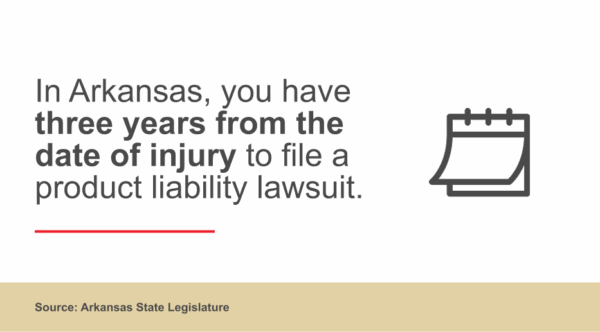
| Filing Deadline | Under Arkansas Code § 16-116-203, product liability actions generally must be filed within three years after the death, injury, or damage complained of occurs. |
| Comparative Fault | Arkansas can reduce compensation when an injured person shares fault. Under Arkansas Code § 16-64-122, a claimant generally may recover when their fault is less than the fault of the party or parties from whom they seek damages, with the recovery reduced by the claimant's percentage of fault. |
Three Types of Product Defects Can Support a Claim
Arkansas's product liability law reaches claims arising from a product's design, manufacture, testing, warnings, instructions, packaging, labeling, and other parts of the product's path to the consumer. Most defective-product claims fall into three familiar categories.
- Manufacturing Defects – The design may be reasonably safe, but an error in materials, assembly, fabrication, or quality control makes the individual product dangerous. A missing fastener, failed weld, contaminated component, or improperly assembled machine can create this type of claim.
- Design Defects – The danger can exist in the design itself, meaning products built exactly as planned may still be unreasonably dangerous. Vehicle components, machine guards, stability systems, and emergency shutoffs can all become design issues.
- Failure to Warn or Instruct – A product may be dangerous because the manufacturer or supplier did not provide adequate warnings, instructions, or information about a foreseeable risk or safe method of use.
Depending on the facts, a product liability action may also involve negligence, breach of warranty, or other legal theories. The right approach depends on what failed, when it failed, and which company controlled that part of the product's design, manufacture, sale, or maintenance.
Dangerous Products We Investigate
Defective-product cases can involve industrial machinery, farm equipment, power tools, heavy equipment, vehicle components, consumer goods, and other specialized products. The common thread is that a product failed in a way that caused injury or property damage.
- Trailer Side Guards – Missing or defective side guards on tractor-trailers can allow underride crashes that cause death, serious head injuries, and spinal trauma.
- Industrial Machinery and Power Tools – Presses, conveyors, forklifts, cranes, hoists, lathes, saws, grinders, hydraulic systems, safety switches, and other equipment can cause crushing injuries, amputations, burns, and other catastrophic harm when a component or safety system fails.
- Farm Equipment – Tractors, combines, augers, power take-off systems, balers, and other agricultural machinery can present product-defect questions when guards, brakes, hydraulics, rollover protection, or other safety features fail.
- Vehicle Parts and Safety Systems – Faulty brakes, steering components, tires, airbags, seat belts, child safety seats, trailer components, and other vehicle defects can turn an otherwise survivable event into a catastrophic crash or injury.
- Household and Consumer Products – Appliances, electronics, batteries, lamps, toys, furniture, and other everyday products can cause fires, electrical injuries, cuts, falls, and other serious harm when they are defective.
Arkansas law generally excludes real estate itself from the definition of a product, although tangible goods installed in or incorporated into real estate can still qualify.
Responsibility Can Extend Across the Supply Chain
A defective product may pass through several companies before it reaches the injured person. Arkansas law defines a supplier broadly enough to include retailers, wholesalers, distributors, and businesses that lease products, while manufacturers can include designers, fabricators, producers, processors, and assemblers.
- Manufacturer or Designer – The company that designed, fabricated, assembled, or produced the product or one of its component parts may be responsible for a defect that existed when the product left its control.
- Component-Part Supplier – A defective hydraulic hose, safety switch, fastener, battery, brake component, or other part can create liability even when the finished product was assembled by another company.
- Wholesaler or Distributor – A company in the distribution chain may qualify as a supplier under Arkansas law and may become part of a strict-liability claim depending on the facts.
- Retailer or Lessor – Retailers and businesses that lease products can also fall within Arkansas's definition of supplier, even when they did not manufacture the product.
- Repair, Maintenance, Owner, or Employer – A separate negligence claim may arise if improper repairs, poor maintenance, removal of a safety feature, or another act created or worsened the hazard. These parties are not automatically product suppliers simply because they owned or serviced the equipment.
One incident can therefore involve both a product liability claim against companies in the supply chain and negligence claims against other parties whose conduct contributed to the injury. Identifying those different theories early helps keep potentially responsible parties and evidence from being overlooked.
Strict Liability Does Not Mean Automatic Recovery
Arkansas recognizes strict product liability, so an injured person does not always have to prove that a manufacturer or supplier acted negligently. But the plaintiff still has to establish the elements of the claim. Under Arkansas Code § 16-116-101, the evidence generally must show that the defendant was in the business of supplying the product, the product was defective and unreasonably dangerous when supplied, the injured person suffered harm, and the defect was a proximate cause of that harm.
That distinction matters when a manufacturer tries to blame the user or someone who handled the product later. Under Arkansas Code § 16-116-206, an unforeseeable alteration, improper maintenance, change, or abnormal use that made an otherwise safe product dangerous can be evidence of fault on the user's side. A careful investigation therefore has to document the product's condition and history, not just the injury.
Preserving the Product Can Make or Break the Case
A product liability claim often depends on physical and technical evidence that cannot be recreated later. Photos are useful, but they may not show a fractured component, manufacturing tolerance, software setting, internal wear pattern, or missing safety feature that becomes obvious only during a controlled inspection.
Whenever possible, the exact product should be secured before it is repaired, returned, scrapped, or transferred to a manufacturer or insurance company. The model and serial number, lot or batch number, labels, warnings, packaging, purchase history, service records, prior repairs, and recall information can all help establish what the product was and what happened to it before the incident.
For machinery and vehicles, electronic or diagnostic information can matter too. Repairs, resets, software updates, or continued operation may overwrite data. An attorney can coordinate with engineering, mechanical, medical, and other qualified professionals to document the product and arrange an inspection that all sides can later account for.
A Recall Can Help, but It Does Not Automatically Prove the Case
A recall, service bulletin, or safety notice can be powerful evidence that a manufacturer identified a problem, but it is not a substitute for proving what happened in the individual case. The injured person still has to connect the defect to the specific product and show that the defect caused the injury. The opposite is also true: the absence of a recall does not necessarily mean a product was safe.
Product Liability Claims Can Include Current and Future Losses
A defective product can cause injuries that last far beyond the first emergency-room visit. When the evidence supports the claim, compensation may address both the losses already incurred and the losses the injury is reasonably expected to cause in the future.
- Medical Care and Rehabilitation – Emergency treatment, surgery, hospitalization, therapy, medication, assistive devices, and reasonably anticipated future care can all become part of the compensation sought.
- Lost Income and Earning Capacity – A serious injury can cause missed work immediately and may permanently reduce a person's ability to earn income in the future.
- Pain, Mental Anguish, and Loss of Enjoyment – Compensation can address the physical and personal impact of an injury that changes daily life, independence, or the ability to participate in activities.
- Permanent Disability or Disfigurement – Amputations, burns, spinal cord injuries, traumatic brain injuries, scarring, and other permanent conditions can substantially increase the long-term consequences of a defective-product injury.
- Property Damage – Arkansas product liability law can also apply to qualifying property damage caused by a defective product.
- Wrongful Death Losses – When a defective product causes a death, surviving family members and the estate may have additional rights under Arkansas wrongful death and survival law.
Why McDaniel Law Firm Handles Complex Defective Product Cases
Product liability cases can place one injured person or family against a manufacturer, distributor, retailer, insurance company, and teams of lawyers. We know these cases require more than sending a threatening letter. We move quickly to preserve evidence, trace the product through the supply chain, obtain design and service records, investigate prior incidents and recalls, and work with the right technical and medical professionals when the case requires it.
Our firm has represented clients in cases involving defective farm machinery, defective autonomous systems, defective side guards on tractor trailers, defective lithium-ion batteries, unsafe industrial equipment, and catastrophic injuries caused by heavy equipment. We have also successfully sued trailer manufacturers over missing side underride guards. That kind of case-specific experience matters when the product itself, the engineering decisions behind it, and the company's records become central evidence.
We also work on a contingency fee basis, which means there are no upfront attorney's fees and you do not owe us an attorney's fee unless we recover compensation for you.
Arkansas Product Liability Frequently Asked Questions
How Long Do I Have to File a Product Liability Lawsuit in Arkansas?
Arkansas Code § 16-116-203 generally gives three years from the date of the death, injury, or property damage complained of to commence a product liability action. That does not mean it is safe to wait. The product can be repaired, discarded, altered, or lost long before the legal deadline expires.
Do I Have to Be the Person Who Bought the Product?
No. Arkansas's supplier-liability statute expressly allows a claim even when the injured person did not obtain the product from, or have a contract with, the supplier. The key questions are whether the defendant qualifies as a supplier, whether the product was defective and unreasonably dangerous, and whether that defect caused the harm.
Can I Still Have a Claim If the Product Was Repaired or Altered?
Possibly. The answer depends on what was changed, whether the change was foreseeable, and whether it caused or contributed to the dangerous condition. Arkansas law allows unforeseeable alteration, improper maintenance, or abnormal use to be considered as evidence of fault. This is one reason preserving repair and maintenance records is so important.
What If I Was Partly at Fault for the Injury?
Arkansas uses modified comparative fault in actions based on fault. If your fault is less than the fault of the party or parties from whom you seek damages, compensation can generally be reduced by your percentage of fault. If your fault is equal to or greater than theirs, recovery can be barred. Manufacturers and insurance companies often raise misuse or alteration arguments, so those accusations should be evaluated against the physical evidence.
Does a Product Recall Automatically Prove Liability?
No. A recall may support the investigation, but the claim still has to connect a defect in the specific product to the injury. Likewise, a product can potentially be defective even if no recall has been announced.
How Much Does a Product Liability Lawyer Cost?
McDaniel Law Firm handles personal injury cases on a contingency fee basis. You pay no upfront attorney's fee, and you do not owe an attorney's fee unless we obtain a recovery for you. We also offer free consultations so you can discuss the product, the injury, and the evidence before deciding what to do next.
Talk to an Arkansas Product Liability Lawyer Before Critical Evidence Disappears
If a defective machine, vehicle component, consumer product, or other dangerous product injured you or someone in your family, contact McDaniel Law Firm, PLC for a free consultation. From our Jonesboro office, we represent clients throughout Northeast Arkansas, including Jonesboro, Paragould, Craighead County, Lawrence County, Greene County, Mississippi County, and Poinsett County, as well as clients elsewhere in Arkansas, Southeast Missouri, and the Memphis area.