
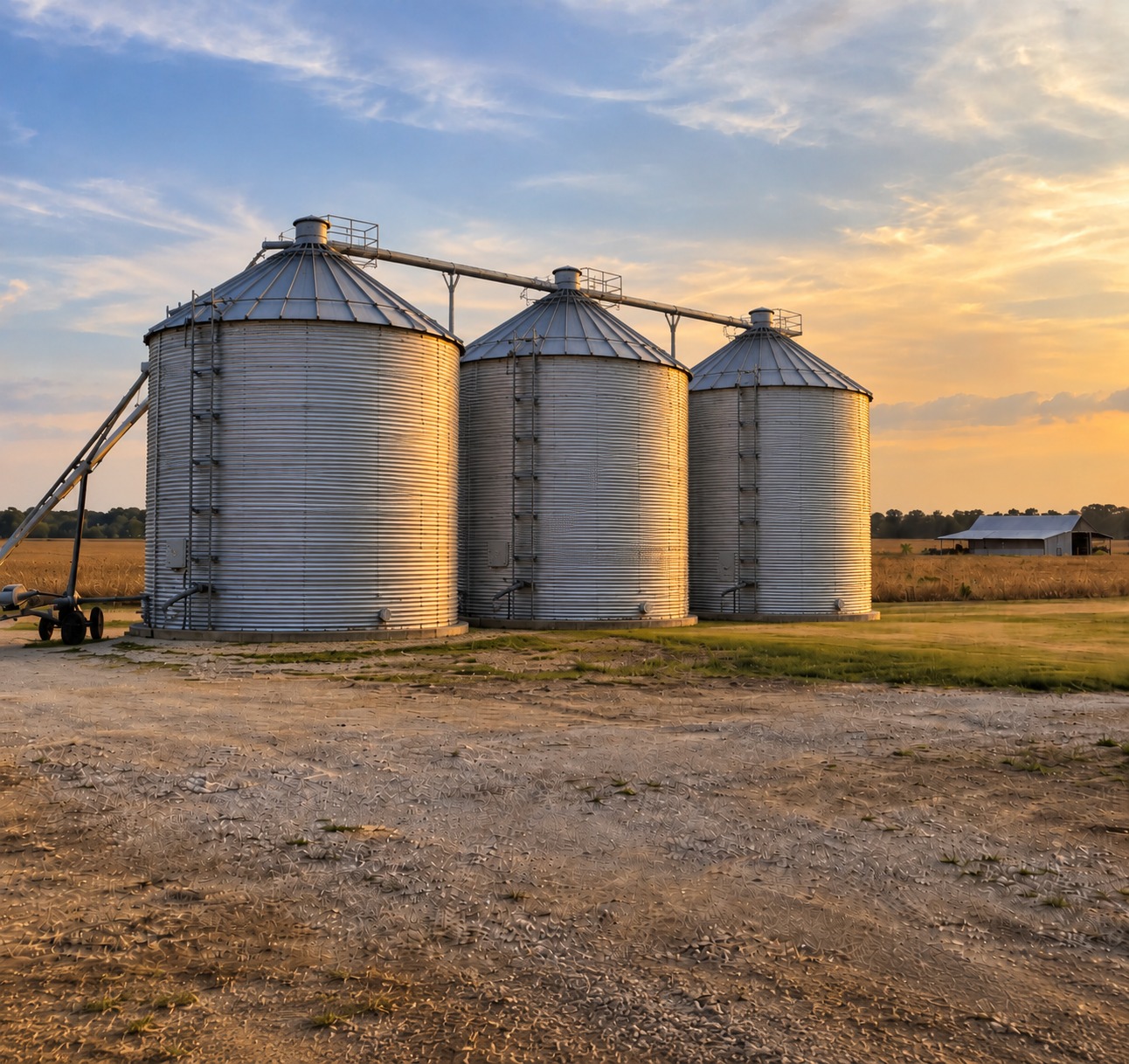
Liability Depends on Why the Grain Bin Accident Happened
Who is liable for a grain bin accident in Arkansas depends on what caused the worker to become trapped, crushed, exposed to a dangerous atmosphere, or injured by grain-handling equipment. A farm owner may be responsible in one case, while another may involve a commercial grain facility, equipment manufacturer, maintenance contractor, or several parties whose failures combined to cause the accident.
Grain bins can become deadly within seconds. Flowing grain can pull a person downward like quicksand, while bridged grain can collapse without warning. Augers, conveyors, sweep equipment, oxygen-deficient atmospheres, toxic gases, falls, and combustible grain dust create additional hazards.
The timing is especially relevant this month. National Farm Safety and Health Week runs September 21-25, 2026, and this year's September 24 focus is agricultural confined-space safety. The hazards are not theoretical. OSHA warns that moving grain can trap a worker in only seconds and that engulfment and suffocation remain among the most serious dangers associated with grain storage.
At McDaniel Law Firm, PLC, our Arkansas farm accident lawyers investigate serious agricultural injuries by looking beyond the accident itself. We examine who owned the property and equipment, who controlled the work, whether machinery was shut down, what safety procedures were in place, whether outside contractors were involved, and whether workers' compensation or a third-party injury claim applies.
More Than One Party May Be Responsible: Depending on how the accident happened, potential defendants can include a farm or facility operator, equipment manufacturer or supplier, maintenance contractor, or another company involved in the work.
OSHA Rules Depend on the Type of Operation: OSHA's grain-handling standard applies to covered commercial grain facilities but expressly excludes on-farm grain storage and feedlots.
Farm Workers Have Special Workers' Compensation Issues in Arkansas: Agricultural farm labor is excluded from Arkansas workers' compensation coverage by default, although an employer can elect coverage.
Third-Party Claims May Still Be Available: Even when workers' compensation applies, Arkansas law generally preserves claims against responsible third parties such as manufacturers or outside contractors.
Arkansas Comparative Fault Can Affect Recovery: A claimant whose fault is equal to or greater than the combined fault of the parties from whom recovery is sought cannot recover under Arkansas's modified comparative-fault rule.
Why Are Grain Bins So Dangerous?
A grain bin may look like a simple storage structure, but grain behaves very differently once it begins to move.
OSHA explains that flowing grain can pull a worker downward within seconds. A person who enters a bin while an unloading auger is operating can become trapped before there is time to climb out or call for help.
Other dangerous conditions include:
- Bridged Grain: Moisture or spoilage can cause grain to form a crust over an empty space. A worker walking across the surface may break through and become buried.
- Wall Collapse: Grain accumulated along the side of a bin can suddenly break loose and engulf someone standing below it.
- Augers and Conveyors: Moving grain-handling equipment can catch clothing, hands, feet, or limbs and cause crushing injuries or amputations.
- Low Oxygen or Toxic Atmospheres: Grain storage structures can contain unsafe oxygen levels, fumigants, mold, or other hazardous gases.
- Grain Dust Explosions: Fine airborne grain dust can ignite when it reaches a sufficient concentration and encounters an ignition source.
- Falls: Workers may fall from bin roofs, ladders, platforms, catwalks, or openings while inspecting or maintaining equipment.
Purdue University's Agricultural Safety and Health Program documented at least 51 agricultural confined-space cases during 2024, including 22 fatalities and 34 grain-related entrapments. Although the numbers vary from year to year, the data continues to show how dangerous grain-storage work can be.
Do OSHA Grain Bin Rules Apply to Arkansas Farms?
Sometimes, but the answer depends on the operation.
29 C.F.R. § 1910.272 contains specific requirements for covered grain-handling facilities such as grain elevators, feed mills, flour mills, rice mills, and certain grain-processing operations.
For covered facilities, those requirements can include employee training, bin-entry procedures, equipment shutdown and lockout, atmospheric testing under certain conditions, body harnesses and lifelines when engulfment hazards exist, an observer stationed outside the bin, and appropriate rescue equipment.
However, OSHA expressly states that § 1910.272 does not apply to on-farm grain storage or feedlots.
There is also a separate federal enforcement limitation involving small farms. OSHA generally cannot spend appropriated funds to conduct enforcement activity against a farming operation with 10 or fewer non-family employees if the operation has not maintained a temporary labor camp during the preceding 12 months. Storing or drying grain grown on that farm ordinarily remains part of the farming operation for purposes of that limitation.
Those distinctions matter. A commercial grain elevator outside Jonesboro may be subject to rules that do not apply to a farmer storing crops grown on the same farm.
An OSHA standard or citation also does not automatically create a private lawsuit. Liability still depends on Arkansas law and the specific legal duties owed by each defendant. Federal safety rules, industry practices, equipment instructions, and other evidence may nevertheless become relevant when attorneys and experts reconstruct how an accident occurred.
Can the Farm Owner or Employer Be Liable?
Potentially, but employment status and workers' compensation coverage have to be examined first.
A farm owner or operator may have played a role in an accident by directing a worker into a dangerous bin, allowing grain to move during entry, failing to shut down machinery, providing unsafe equipment, failing to warn about known hazards, or failing to provide appropriate training or supervision.
That does not automatically mean the injured worker can bring an ordinary negligence lawsuit against the employer.
Arkansas workers' compensation law generally excludes agricultural farm labor from covered employment. However, Arkansas Code § 11-9-403 allows an employer engaged in otherwise excluded employment to elect workers' compensation coverage.
If workers' compensation applies, Arkansas Code § 11-9-105 generally makes those benefits the employee's exclusive remedy against the covered employer for the workplace injury.
If agricultural employment was not covered, the legal analysis can be very different. The worker may need to determine whether an ordinary negligence claim is available against the farm owner or another responsible party.
This is one reason a farm accident claim should not begin with the assumption that every injured farm worker has the same legal remedy.
Can a Commercial Grain Elevator or Storage Company Be Responsible?
Yes, when the company's negligence contributes to the accident.
A commercial grain elevator or other covered grain-handling facility may have responsibility for training, bin-entry procedures, equipment shutdown, hazardous atmospheres, rescue planning, and other workplace safety measures.
An investigation may ask:
- Was an entry permit required and completed?
- Were augers, conveyors, and other hazardous equipment properly de-energized and locked out?
- Was grain moving while the worker was inside?
- Was the worker equipped with required fall or engulfment protection?
- Was an observer stationed outside the structure?
- Was rescue equipment available?
- Were workers trained about engulfment and mechanical hazards?
- Did supervisors know about bridged grain or material accumulated along the bin wall?
The answers can help show whether a preventable safety breakdown occurred and which company controlled the hazardous work.
Can an Equipment Manufacturer Be Liable?
A grain bin accident can also become a product liability case.
Arkansas law allows liability against a supplier when a product was supplied in a defective condition that rendered it unreasonably dangerous and the defect proximately caused the injury.
Potential defects may involve:
- Auger Guards: A missing, inadequate, or defective guard may expose workers to dangerous moving parts.
- Emergency Shutoff Systems: A defective switch or control can prevent equipment from being stopped when someone becomes trapped.
- Interlocks and Sensors: Safety devices designed to prevent operation during maintenance or entry may fail.
- Warnings and Instructions: A manufacturer may face allegations involving inadequate warnings about foreseeable engulfment, entanglement, electrical, or mechanical hazards.
- Bin or Equipment Design: The investigation may identify a design or manufacturing defect that created an unreasonable danger during normal or foreseeable use.
The equipment should be preserved whenever possible. Altering, repairing, discarding, or returning machinery before it can be inspected may destroy important evidence about the cause of the accident.
Can a Maintenance Company or Other Contractor Be Liable?
Outside contractors can become important third parties in a grain bin case.
A maintenance company may have negligently repaired an auger, bypassed a safety mechanism, failed to replace a guard, or returned malfunctioning machinery to service. Another contractor may have been responsible for electrical work, ventilation, bin cleaning, fumigation, grain removal, or equipment installation.
If that contractor's negligence caused or contributed to the accident, the injured person may have a separate claim against the contractor.
That can be especially important when workers' compensation applies. Under Arkansas Code § 11-9-410, a workers' compensation claim generally does not eliminate the injured employee's right to pursue a responsible third party.
The same principle can apply when a defective component or negligent outside service company contributed to an accident involving grain-handling or other farm machinery.
1. Determine Who Controlled the Work: The investigation identifies the farm owner, employer, grain facility, contractors, equipment owners, and anyone else who controlled the bin, machinery, or work being performed.
2. Determine What Failed: Attorneys and experts examine whether the accident involved flowing grain, unsafe entry, missing lockout procedures, defective equipment, poor maintenance, inadequate training, hazardous air, or another preventable condition.
3. Determine Which Legal Remedy Applies: The injured worker's employment status, workers' compensation coverage, OSHA applicability, product-liability law, comparative fault, and potential third-party claims all affect who may ultimately be responsible.
How Does Arkansas Comparative Fault Affect a Grain Bin Claim?
Arkansas follows a modified comparative-fault rule under Arkansas Code § 16-64-122.
If the injured person's fault is less than the combined fault chargeable to the party or parties from whom damages are sought, the person can recover, but the award is reduced in proportion to their own fault.
If the injured person's fault is equal to or greater than the fault chargeable to those defendants, recovery is barred.
That means the common shorthand of a "50% rule" needs some precision. If the claimant and defendants are each assigned 50% of the fault, the claimant does not recover because the claimant's fault is not less than the defendants' fault.
Defendants may argue that a worker ignored instructions, entered a bin unnecessarily, failed to use available safety equipment, or knowingly approached moving machinery. The injured person's attorneys may need to answer those arguments with evidence about training, supervision, work instructions, safety equipment, machinery condition, and what actually happened immediately before the accident.
What Evidence Should Be Preserved?
Grain bin accidents can change quickly after emergency responders arrive. Grain is removed, equipment is restarted or repaired, and physical conditions inside the bin can disappear.
Important evidence may include:
- Photographs and Video: Images of the bin, grain level, machinery, guards, controls, ladders, openings, warning labels, and surrounding work area can preserve conditions that later change.
- Equipment and Components: Augers, guards, switches, sensors, electrical controls, harnesses, and failed components may require inspection by engineering experts.
- Training and Safety Records: Documents may show what employees were taught about entry, lockout procedures, flowing grain, hazardous atmospheres, and rescue.
- Maintenance and Repair Records: These can identify prior equipment problems, repairs, bypassed safety systems, or repeated breakdowns.
- Witness Statements: Coworkers, contractors, truck drivers, family members, and others may know whether grain was moving, who gave instructions, or what safety equipment was available.
- Electronic and Operational Records: Control-system data, work orders, schedules, grain-transfer records, text messages, and communications may help establish the timeline.
- OSHA Materials When Applicable: Inspection records, citations, photographs, interviews, and prior enforcement history may contain useful evidence at covered facilities.
A lawyer can send preservation notices and arrange appropriate inspections before equipment or records disappear.
What If the Grain Bin Accident Was Fatal?
Engulfment, asphyxiation, explosions, and severe machinery injuries can all be fatal.
When negligence or a defective product causes a death, surviving family members may have rights under Arkansas's wrongful death law.
Arkansas Code § 16-62-102 generally gives three years from the death to commence a wrongful-death action, although the particular facts and claims should always be reviewed individually.
A fatal workplace accident may also require an analysis of workers' compensation death benefits, agricultural-labor exclusions, employer immunity, and possible third-party claims.
How Long Do You Have to File an Arkansas Grain Bin Accident Claim?
Many Arkansas personal injury claims are subject to a three-year limitations period, and Arkansas product-liability actions generally must also be commenced within three years of the injury or death.
That does not mean every grain bin case has one universal three-year deadline. Workers' compensation claims have their own requirements, and other defendants or legal theories can create different procedural issues.
Grain bin cases are especially evidence-sensitive. The machinery may be repaired, grain removed, surveillance overwritten, and witnesses scattered long before the statute of limitations expires.
McDaniel Law Firm Investigates Serious Arkansas Farm Accidents
For more than 50 years, McDaniel Law Firm, PLC has represented injured people and families throughout Arkansas. Our attorneys handle serious farm accident, defective-product, catastrophic-injury, and wrongful-death claims involving complex questions about how an accident happened and who should be held responsible.
A grain bin accident may involve an Arkansas farm, a national equipment manufacturer, a commercial grain business, an outside contractor, or several companies at once. We investigate each potential source of responsibility instead of assuming the most obvious party is the only one that matters.
If you or someone you love was seriously injured or killed in a grain bin accident, contact McDaniel Law Firm, PLC for a free consultation. We can determine which safety and employment laws apply, preserve the equipment and records, identify every potentially responsible party, and explain the compensation that may be available. You pay no attorney's fee unless we recover compensation for you.